Showing posts with label hunter-gatherers. Show all posts

Thursday, March 12, 2009

Grann on the lost Amazonian tribe "hoax"

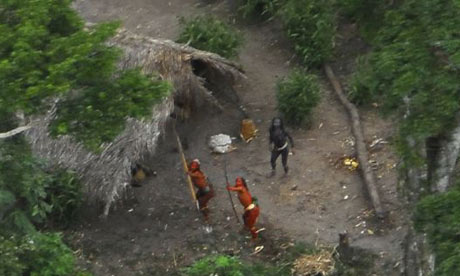
A few months back we were talking about the so-called "lost Amazonian tribe" that had been much discussed in the news in May of 2008.


David Grann has an interesting post with an update on the 'hoax' at the Huffington Post. Some of it is publicity for his new book, but there's some interesting information, and useful back links, so I thought I'd link to it here as well. It raises some thought-provoking questions on the reporting of anthropological news, especially in this day of 24 hour news cycles. Here's an excerpt:
The dispute over the photographs stemmed from confusion over the meaning of "uncontacted," as these groups are commonly designated. Though Meirelles had never said the tribe was unknown, many in the press had initially portrayed the group as such. In fact, like many of these tribes, the group's existence had had long been known about--its presence detected either by frontiersmen or by satellite imagery. Indeed, it is likely that many of these tribes have had some form of fleeting "contact" with outsiders over the years.

But that did not make the photographs "fakes" or a "hoax." The reason these tribes are classified as "uncontacted" is because they have retreated into the jungle and consciously avoided any interaction with settlers--an interaction that has frequently led to the extinction of Amazonian tribes.
Might making yourself 'uncontacted' be a form of territoriality driven by concerns not considered in the readings on the topic we discussed?

Tuesday, February 17, 2009

Kids did the darndest things (repost)

This is a repost from my main blog, originally published on January 9th, 2008. I figured it might be interesting since it talks about some of the issues related to the identification of the activities of children in the archaeological record. If you're interested in the topic of the archaeological visibility of children, you might also want to check out the AP3A volume "Children in Action: Perspectives on the Archaeology of Childhoods" which can be accessed through McGill.

***************************************

Over at Afarensis, we find a brief discussion of a recent paper about the contribution of children to the Lower and Middle Paleolithic archaeological record (i.e., Stapert 2007 – available as a free pdf). Afarensis seems to agree with Stapert that there has been a generalized tendency to not think of children as important accumulators of artifacts – in this case stone implements – in periods prior to the Upper Paleolithic, which is a euphemism for “prior to the dominance of Homo sapiens in the fossil record.” Stapert’s paper is really quite thought-provoking and casts a new and in my view fairly convincing interpretive light on a wide range of published anecdotal remarks about ‘failed flints’ in Lower and Middle Paleolithic (as well as two Châtelperronian) assemblages.

I think that people are starting to come to grips with the idea of pre-Late Pleistocene kids contributing to the archaeological record (e.g., Shea 2006), even if this growing awareness has yet to translate into a systematic incorporation of children’s activities and learning in paleoanthropological interpretation. In spite of this, it’s worth wondering why archaeologists who have studied hominins that were the quintessential hunter-gatherers have taken so long to come to grips with the idea that their social structure and technological transmission mechanisms might parallel those of ethnographically-documented foragers. To take an example based on a prior post, if Neanderthals had life-histories comparable to those of modern humans, there is every reason to believe that the acquisition of essential skills for Upper and Middle Paleolithic foragers would have stretched over a significant period of time. The starting assumption should therefore be that children were important accumulators of likely often ‘odd looking’ archaeological remains.

Stapert highlights that researchers seem to have little problem invoking the activities of children to account for roughshod lithics in Upper Paleolithic assemblages but do not appear inclined to do so for Lower and Middle Paleolithic assemblages. As argued by Shea (2006:214):
“One possible reason for this is that for relatively simple knapping techniques there may be few differences between the byproducts of experienced adults and those of novice knappers. This argument is plausible for pebble-core components of Paleolithic industries, but seems less plausible for the prepared- core components (Acheulean bifaces, Levallois cores, prismatic blade cores, and foliate bifaces) that populate Paleolithic industries from 1.7 Myr onward.”
This being the case, Staper asks bluntly but rightly “is it harder to imagine children and their activities when one is dealing with species other than modern humans?” (2007:35).

I would argue that this is almost certainly one of the principal reasons since, to follow up on my earlier example, by not considering the role of Neanderthal children in interpretations of the Middle Paleolithic record, it becomes easier to cast those hominins as different. To a degree, this perspective is reflected by the following kind of circular reasoning: “Well, Neanderthal children surely didn’t play a significant role in the accumulation of that sub/species’ archaeological record. Therefore what we document archaeologically reflects adult, fully competent Neanderthal behavior. But that behavior departs in significant ways from how we expect fully competent, adult Homo sapiens knappers to structure their lithic production and lithotype management. Ergo, we have yet more evidence that Neanderthals were behaviorally distinct from Homo sapiens.”

And here, I think we get to at least some of the heart of the matter – paleoanthropologists as a whole have invested a great deal of time and energy in trying to show how pre-Homo sapiens hominins were distinct from Upper Paleolithic humans rather than attempting to understand them primarily as foraging hominins who were very successful at eking out a living in the Pleistocene Old World. While there are obviously good reasons to do so in certain regards, approaching Neanderthals and earlier hominins first and foremost as foragers independent of preconceptions of how different they must have been is often a very rewarding way of doing archaeology that opens up fruitful interpretive avenues. Of course, one must be careful to not swing the pendulum too far in that direction and become oblivious to the differences that do exist. However, at this stage of the game, I think that the advantages of a self-aware approach to Neanderthals that views them first and foremost as hunter-gatherers outweigh its disadvantages as far as reaching a thorough understanding of the lifeways of non-sapiens hominins – both adult and juvenile – is concerned.

References:

Shea, J. J. 2006. Child’s play: Reflections on the invisibility of children in the Paleolithic record. Evolutionary Anthropology 15: 212-216.

Stapert, D. 2007. Neanderthal children and their flints. Palarch’s Journal of Archaeology of Northwestern Europe 1(2): 16-39.
Moving as a way of living

Hot on the heels of last week's discussion about mobility and intersite variability, here's a news report on some research done by Claudio Aporta (Carleton University) on how moving and mobility strategies form integral parts of Inuit cultural identity (Aporta 2009). Based on his analysis, it seems that that moving about is not only a utiliatarian strategy to best procure resources for the Inuit. That is, the Inuit don't simply use mobility as a way of bringing people to resources or resources to people. Rather, it seems like their mobility strategies and all of the knowledge it entails are a defining feature of who they are, how they relate to other social groups and how it structures their social organization. To put it in terms we recently discussed, Inuit mobility may be more 'informational' and 'network' (sensu Whallon (2006)) than simply logistical or residential in nature. That being the case, it is perhaps not surprising that many high latitude groups did not conform to the expectations of Binford's (1980) model.

Here's a blurb from the Science Daily report:

Using a combination of historical documents, ethnographic research, geographic tools including GPS, GIS and Google Earth, as well as a recent journey following Inuit along a traditional trail, Dr. Aporta shows the geographic extent of the Inuit’s sophisticated network of routes. He describes how the Inuit have made use of the Arctic environment and how their trails represent significant channels of communication and exchange across the territory. To the Inuit, the Arctic is a network of trails, connecting communities to their distant neighbors, and to fishing lakes and hunting grounds in between.

What is remarkable is that although the trails are not permanent features of the landscape, their locations are remembered and transmitted orally and through the experience of travel. They do not use maps to travel or to represent geographic information. Rather the journey along the trail, or the story of the journey, becomes one of the main instruments for transmitting the information.


It's very interesting that the story of the journey becomes the longest-term important cultural artifact rather than whatever was procured as part of a given instance of travel. In a way, this is reminiscent of a thought-provoking paper by Caroline Funk (2004) who had argue that simple behavioral ecological models were insufficient to understand how Arctic groups structured their land-use strategies in prehistory. Which makes me wonder how Aporta's results and perspective fit in with a recent paper on human wayfinding in some highly mobile human groups in high latitudes (i.e., in Finland reindeer pastoralists) published by Istomin and Dwyer (2009:29) who argue that "humans rely on mental maps but also memorize vistas while navigating, and an individual's navigation method, ability, and the form of the mental map is likely to depend on a situation as well as on factors such as age, sex, familiarity with the environment, and life history."

References:

Aporta, C. 2009. The Trail as Home: Inuit and Their Pan-Arctic Network of Routes. Human Ecology doi: 10.1007/s10745-009-9213-x.

Binford, L.R. 1980. Willow smoke and dogs' tails: hunter-gatherer settlement systems and archaeological site formation. American Antiquity 45:4-20.

Funk, C. 2004. Optimal foraging theory and cognitive archaeology: Cup'ik cultural perception in southwestern Alaska. In Hunters and gatherers in theory and archaeology (ed. G. Crothers), pp. 279–98. Southern Illinois University Center for Archaeological Investigations Occasional Paper 31. SIUC, Carbondale, IL.

Istomin, K.V., and M.J. Dwyer. 2009. Finding the Way: A Critical Discussion of Anthropological Theories of Human Spatial Orientation with Reference to Reindeer Herders of Northeastern Europe and Western Siberia. Current Anthropology 50:29-50.

Whallon, R. Social networks and information: Non-"utilitarian" mobility among hunter-gatherers. Journal of Anthropological Archaeology 25:259-270.

Tuesday, February 3, 2009

Biodiversity and late Neanderthal survival

There's an interesting tidbit in today's Science Daily about how a refugium area around Gibraltar may have helped Neanderthal foragers survive there up to ten millennia later than elsewhere in Europe.

"... when a large part of the European continent was covered in ice and snow, Neanderthals in the region of Gibraltar in the south of the Iberian peninsula were able to survive because of the refugium of plant and animal biodiversity. Today, plant fossil remains discovered in Gorham's Cave confirm this unique diversity and wealth of resources available in this area of the planet."


You can access the report here. Interesting how resource abundance is tied to the stability of a forager system so far back in the past.

Monday, February 2, 2009

Quote of the day

Cross-posted at A Very Remote Period Indeed.

A noteworthy passage from R.L. Kelly's The Foraging Spectrum: Diversity in Hunter-gatherer Lifeways (1995, pp. 261-262):

Though stereotyped images of hunter-gatherer social organization, especially relations between men and women (equality or inequality), are sometimes take to be ancient behavior rooted in Pleistocene adaptations, we repeat that this is not necessarily true. Modern hunter-gatherers do not live out the presumed legacy of their (and our) Plio-Pleistocene ancestors any more than we do. Instead, diversity or similarities in behavior are the result of diversity or similarities in selective pressures and enculturative environments.